How to launch a jewelry webshop that stays in sync with your physical store
A practical guide to selling jewelry online without running two systems, with a webshop that always reflects your real stock, prices, and customers.
 By Thomas De Bonnet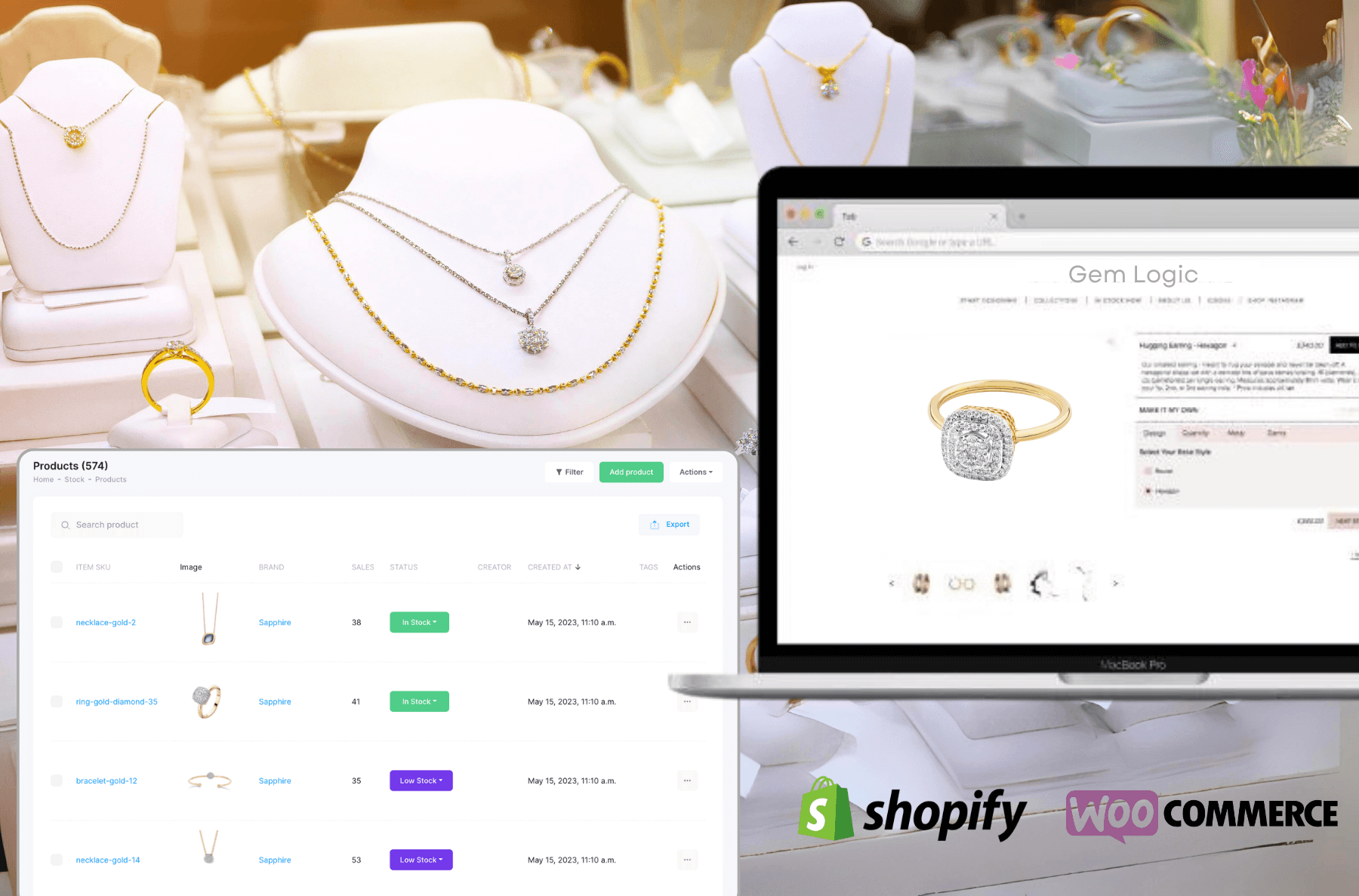
Most jewelers who launch an online store run into the same problem within a few months. A customer buys a ring through the website. The same ring is still sitting in the window of the physical store. Someone comes in and asks for it. The piece is already sold, the customer in the shop is disappointed, and the team spends twenty minutes untangling the confusion.
This is not a technology problem. It is an integration problem. The webshop and the store are running as two separate systems, and nobody built a reliable bridge between them.
This guide is for independent jewelers and small jewelry chains who want to sell online without doubling their administrative workload. We will cover what a properly synced jewelry webshop looks like, why jewelry specifically requires more than a standard Shopify template, how to connect your online catalog to your physical stock, and what to do if you are already on WooCommerce or Shopify and want to fix the sync problem without starting over.
Why jewelry is harder to sell online than most products
Before getting into setup, it helps to understand what makes jewelry technically more demanding than selling shoes or books online.
A single ring is not one product. It is a combination of a metal type (yellow gold, white gold, platinum), a karat weight, a stone (with its own clarity grade, color, cut, and carat weight), a ring size, and possibly a certificate number. Each of those combinations is a variant. Some variants are in stock. Some can be made to order. Some are one-of-a-kind pieces that cease to exist the moment they sell.
Generic e-commerce platforms were not designed for this. They treat a product as a SKU with a quantity. Jewelry does not work that way. The result is either a badly simplified product page that strips out all the information a buyer needs, or an enormous SKU explosion that becomes unmanageable to maintain.
There is also the pricing layer. The value of a gold piece fluctuates with the precious metal market. A price you set on Monday may be below cost by Friday if gold moves sharply. Selling jewelry online without live metal pricing is a liability most jewelers do not think about until it hurts them.
And then there is trust. For a piece worth a thousand euros or more, customers want to see certificates, provenance, and high-quality photography. They want reassurance on shipping insurance, return policy, and the ability to ask a human a question before purchasing. A generic store template does none of this well by default.
Getting the sync right is only one part of launching a successful jewelry webshop. The other part is building a storefront that actually converts. Both require a setup designed specifically for jewelry.
What "in sync" actually means in practice
When a jeweler says they want their webshop to stay in sync with the store, they usually mean one thing: stock levels. If something sells in the store, it should disappear from the website. That is the right instinct, but it is only part of what a properly integrated system does.
Full sync covers four things.
- Stock moves in both directions. A sale in the physical store reduces online availability immediately. A sale online triggers the same inventory reduction in your POS and removes the piece from the in-store display list. For one-of-a-kind pieces, the product goes offline automatically the moment it sells.
- Prices stay accurate. For bullion items and pieces priced by metal weight, live metal pricing keeps your online prices tied to the current market. You set a margin and the platform handles the rest.
- Customer records are unified. When someone buys online, they become a customer in your CRM, with their purchase history, preferences, and contact details sitting next to anyone who bought in store. The next time they come in, your team already knows them.
- Orders flow into the same workspace. An online order lands in the same pipeline as a counter sale or a repair job. No switching between dashboards, no manual data entry, no end-of-day reconciliation between the webshop and the till.
This is what separates a connected jewelry webshop from a standalone online store that happens to sell the same products as your physical location.
Three ways to set up a synced jewelry webshop
Depending on where you are starting from, there are three realistic paths.
The first is building your webshop inside your jewelry management platform. This is the cleanest option because the shop and the back office are the same system from day one. Gem Logic builds and hosts jewelry webshops directly, with custom design delivered as a single project. The storefront is connected to your catalog, your stock, your pricing rules, and your customer records before the first product goes live. There is no integration to maintain because there is nothing separate to integrate. When you add a product in Gem Logic, it appears on the website. When it sells, it is gone from both.
The second path is connecting your existing platform. If you already have a WooCommerce or Shopify store with history, reviews, and traffic you do not want to lose, Gem Logic connects to both. Stock, orders, and customer data flow between the platform and your Gem Logic back office. This is a good option for jewelers who are happy with their front-end but want to replace the disconnected back-end with something built for jewelry.
The third path is migration. If your current platform is creating more problems than it solves and a fresh start makes sense, Gem Logic can migrate your product catalog and customer records and build a new storefront in the process. For jewelers moving off old desktop software or outdated platforms, this is often the most efficient route.
What to prepare before you launch
A jewelry webshop is only as good as the data behind it. Before going live, there are five things worth getting right.
- Your catalog needs to be clean and complete. Every piece that goes online needs a title, a clear description, accurate material and stone details, pricing, and at least one high-quality photograph. Missing data is not a minor issue online: a product page with incomplete information loses the customer before they reach the add-to-cart button. Gem Logic's AI image tools help jewelers who do not have studio photography for every piece, generating clean backgrounds and lifestyle-style shots from standard photos.
- Stock quantities need to be accurate. If your physical inventory has not been reconciled recently, that is the first thing to fix. Launching with incorrect stock counts means the sync problems start on day one rather than being prevented by it.
- Your certificate and provenance data should be attached to the right products. For pieces that come with GIA or IGI certificates, that information belongs on the product page. It builds trust and reduces pre-sale questions. Gem Logic surfaces certificates and provenance directly on the product page when they exist in the record.
- Your pricing rules need to be defined. Which pieces are fixed price? Which are priced by metal weight and need live market adjustments? Defining this before launch prevents pricing errors from reaching customers.
- Your payment and shipping setup needs to match what you actually offer. High-value jewelry shipping requires insurance. Your checkout should reflect the carriers and coverage options you use, with clear delivery times and a human contact point visible before checkout.
The product page is where most jewelry webshops lose the sale
Drive traffic to a badly built product page and you will have nothing to show for it. The product page is the hardest part of selling jewelry online, and it is where generic store templates fall the furthest short.
A jewelry product page needs to do several things at once. It needs to present the piece beautifully, with multiple photos showing it from different angles, ideally on a model or against a neutral surface. It needs to give the customer the technical information they actually want: metal type, karat, stone weight, dimensions, certificate number if applicable. And it needs to make variants easy to navigate: if the ring comes in yellow gold, rose gold, and platinum, the customer should be able to switch between them and see the correct image and price update immediately.
For higher-value pieces, it needs to offer a clear path to a human conversation. A "Book a private viewing" button on the product page converts well for engagement rings and statement pieces. The customer is interested but not ready to add to cart. Give them somewhere to go other than leaving. This ties directly into your appointment system and keeps the lead in your pipeline.
Trust signals matter more here than on most other product categories. Secure payment icons, insured shipping details, a clear return policy, and visible contact information should not be hidden in the footer. They belong near the add-to-cart button, where the buying decision happens.
How sync works when you are already on Shopify or WooCommerce
If you built your online store on Shopify or WooCommerce before implementing a proper jewelry management system, you are not alone. Many jewelers end up there because both platforms are well-known and easy to start with. The problem is the back-end: when stock lives in Shopify and in a spreadsheet and in a separate inventory system, none of them are ever fully accurate.
Gem Logic connects to both Shopify and WooCommerce as a data layer underneath. Your existing storefront stays in place. Your product listings, reviews, and SEO history are not affected. What changes is where the data comes from. Stock levels, prices, and product details are managed in Gem Logic and pushed to your Shopify or WooCommerce front-end in real time. Orders from the webshop flow back into Gem Logic and appear in the same workspace as your in-store sales.
This means you get the sync without a replatform. For jewelers who have spent years building traffic and reviews on their existing store, that matters.
If at some point you do want to move your storefront onto the Gem Logic platform, the catalog and customer data are already there. Migration becomes a design and build project rather than a data excavation.
Keeping the catalog fresh after launch
One of the most common reasons jewelry webshops lose momentum after launch is that the catalog stops being updated. New pieces come into the store but never make it online. Products sell out in the physical location and sit as available on the website for weeks. Seasonal collections go live two months after the season ends.
These are not technology failures. They are workflow failures. The fix is making it frictionless to publish new products to the web as part of the same process you use to add them to your inventory.
In a connected system, this is the default. When a new piece is entered into your product catalog with photos and pricing, it can be set to publish online immediately or held for a scheduled release. Stock changes propagate automatically. There is no separate webshop admin to log into, no copy-pasting product information between systems, no manual price updates.
The discipline of keeping the catalog fresh is easier to maintain when it does not require extra steps. If adding a product to the store and adding it to the website are the same action, it actually gets done.
What comes after launch
A jewelry webshop is not a one-time project. It is a channel that needs the same ongoing attention as your physical store, just in a different form.
After launch, the areas that drive results most reliably are search visibility (making sure your product pages and category pages rank for the terms customers actually use when looking for jewelry), conversion rate (testing product pages, photography, and trust elements to increase the percentage of visitors who buy), and retention (using your unified customer records to bring existing buyers back through targeted email, anniversary reminders, and private previews of new collections).
All of this compounds more effectively when your customer data is in one place. A customer who bought an engagement ring two years ago and whose anniversary is coming up is a warm lead for a gift. You only know that if the webshop purchase, the in-store visit history, and the CRM data are in the same system.
The Gem Logic ecommerce build is designed as a long-term partnership. After launch, new collections, seasonal campaigns, and conversion improvements continue as the business grows. The goal is not to deliver a website and disappear, but to keep the storefront evolving alongside the store.
Conclusion
Launching a jewelry webshop that actually works means solving two problems at once: building a storefront designed for how jewelry is actually sold, and connecting it tightly enough to your physical operation that stock, prices, and customer data never fall out of sync.
The first problem requires jewelry-specific thinking on product pages, variants, certificates, and trust. The second requires a back-end built for the jewelry trade, not adapted from a general retail platform.
Both are solvable. The jewelers who get this right are the ones who treat their online store as an extension of the same operation, not a separate project running in parallel.
Key takeaways
A synced jewelry webshop reflects your real stock in both directions: a sale online reduces your physical inventory, and a sale in store removes the product from your website immediately. Jewelry product pages require variants, certificates, live pricing, and trust signals that generic templates do not provide.
Whether you are starting fresh, connecting Shopify or WooCommerce, or migrating an existing catalog, the goal is one back-end that drives all channels. Keep the catalog fresh by making it part of the same workflow as your regular inventory management, and treat the webshop as a long-term channel rather than a one-time setup.
See how Gem Logic connects your physical store and your online shop in one workspace
Explore the ecommerce features, or book a demo to see the sync in action.