
A customer finds a ring on your website on a Saturday afternoon. They add it to their cart, complete the checkout, pay, and receive a confirmation. On Monday morning, your staff opens the store and realizes the same ring sold to a walk-in customer on Saturday. It was never removed from the website because nobody updated it over the weekend. Now you have a paid online order, an unhappy customer, and a refund to process before the week has even started.
This is not a rare scenario. For any jewelry store running a webshop and a physical POS as two separate systems, it is an inevitability. Not a question of if, but of when.
This article is for jewelers who already sell in both channels, or are about to, and want to understand what a disconnected setup actually costs, what a connected one makes possible, and how to close the gap without rebuilding everything from scratch.
The hidden cost of running two separate systems
The double-sold item is the most visible failure, but it is not the most expensive one. The daily friction of two disconnected systems adds up faster.
- Stock levels are always slightly wrong. Because your webshop and your POS maintain separate inventory counts, they drift apart every time a sale happens in either channel without an immediate update to the other. Staff spend time at the end of the day or week manually reconciling what sold where, correcting quantities, and chasing discrepancies. This is time that does not show up as a line item anywhere, but it accumulates.
- Customer records are split. A customer who bought an engagement ring in your store two years ago and now orders a chain online is treated as a new customer by your webshop. There is no combined purchase history, no unified profile, no way to recognize them automatically or personalize the follow-up. Every sale is an island.
- Pricing gets out of sync. You update a price in your POS because gold moved. The website still shows last week's price. A customer adds to cart at the old price and expects that price at checkout. This creates either a margin problem or a customer service problem, neither of which you want.
- Reporting is incomplete. You have webshop revenue in one dashboard and in-store revenue in your POS, and getting a true picture of the business requires exporting both, combining them manually, and hoping nothing is double-counted. Most jewelers stop doing this and end up making decisions on partial data.
None of these are catastrophic on their own. Together, they represent a significant operational drag that grows proportionally with your volume. The busier the store, the more painful the disconnect.
What actually happens when your POS and website are connected
A connected setup does not just eliminate the problems above. It changes how the business operates.
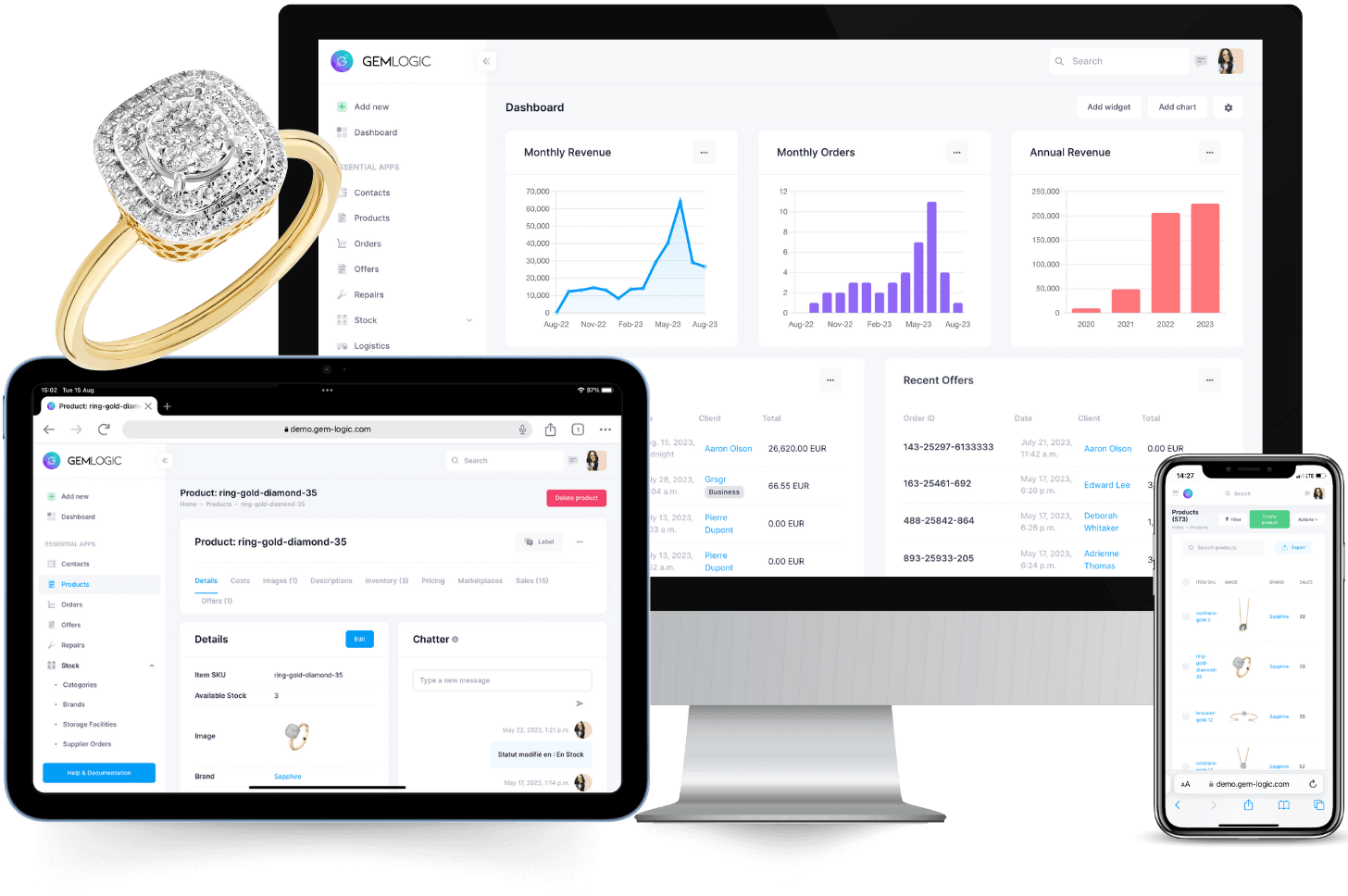
- A piece sells at the counter, and it disappears from the website within seconds. Not at the end of the day, not after a manual update, immediately. The Gem Logic POS and the webshop share the same inventory layer. A sale in either channel is a single event that updates both simultaneously.
- A customer buys online, and the order lands in the same workspace as your counter sales. Your CRM records the purchase against their profile, which already includes anything they bought in store, any repairs you have done for them, their ring size, their partner's preferences, their anniversary date. The next time they walk in, your staff sees the full picture.
- You change a price in the back office, and it updates everywhere. The POS shows the new price. The website shows the new price. For pieces tied to precious metal values, live metal pricing keeps both channels accurate automatically without anyone touching a product record.
- You run a promotion or issue a gift card, and it works in both directions. A gift card sold in store can be redeemed online. A discount code created for an email campaign works at the physical counter too. Gift cards and vouchers are not channel-specific because the channels are not separate.
Why generic POS systems make this problem worse
Most jewelry stores that end up with a disconnected setup did not choose it deliberately. They chose a POS that worked well enough for in-store sales, then later added a webshop, and discovered that connecting the two required either expensive custom development or a subscription to yet another middleware tool that never quite worked reliably.
Generic POS systems were not designed with the jewelry trade in mind. They handle basic retail well: a product with a SKU, a quantity, a price. Jewelry does not fit that model. A ring is not one SKU. It is a combination of metal, stone, size, and weight, each combination potentially with its own price, stock status, and certificate. A generic POS struggles to represent this accurately, which means the data going into any integration is already imprecise before a single sync runs.
The result is jewelers maintaining two systems that are always slightly out of agreement, patched together with exports, imports, and manual corrections. The more channels they add, the worse it gets.
The repair workflow is where disconnected systems fail most visibly
Repairs are the clearest example of what breaks when your systems do not talk to each other.
A customer drops off a piece for a repair. It is logged in your repair management system with a ticket, a deadline, and a photo, the way modern repairs should be run. The repair is completed, the piece is ready for pickup. But the customer also has a pending order in the webshop from last week. Without a connected system, the staff member handling the repair pickup has no visibility of the online order. The customer leaves with the repaired piece. The open order sits unresolved. Nobody connects the two until the customer contacts you asking about it.
This kind of fragmentation does not just create operational errors. It makes customers feel like they are dealing with two different businesses. When your POS and your website are connected, the customer profile surfaces everything, the open webshop order shows alongside the repair ticket, and the interaction feels coherent because the data underneath it is coherent.
Already on Shopify or WooCommerce? You do not have to start over
Many jewelers reading this are already running a webshop on Shopify or WooCommerce and a separate POS. The idea of replacing either one feels disruptive, and rightly so. A webshop with established traffic, product reviews, and SEO history is worth protecting.
Gem Logic connects to both Shopify and WooCommerce without requiring you to replatform. Your existing storefront stays in place. What changes is the layer underneath. Stock, pricing, and customer data are managed in Gem Logic and pushed to your existing store in real time. Orders from Shopify or WooCommerce flow back into Gem Logic and appear alongside your in-store sales.
This means the sync problem is solved without touching your front-end. Your product pages, your URLs, your reviews, your organic rankings are all preserved. The back-end becomes a single source of truth that drives both channels instead of two separate databases drifting apart. It is the same foundation behind launching a webshop that stays in sync with your store.
If you later decide to move your storefront onto the Gem Logic platform, the ecommerce build becomes a design and migration project rather than a data reconstruction, because the catalog and customer records are already there.
What to look for in a connected jewelry system
If you are evaluating how to solve this for your store, there are a few things worth checking before you commit to any platform.
- The sync should be real-time, not batch. End-of-day stock updates are not enough for a jewelry store with limited quantities of unique or near-unique pieces. A piece that sells at 14:00 should be offline by 14:00, not by midnight.
- Customer records should be truly unified, not just linked. A connected system creates one customer profile that captures every interaction across every channel. A linked system creates two profiles that sometimes talk to each other. The difference matters when you are trying to do anything useful with the data.
- The POS needs to handle jewelry-specific workflows natively. Gold buying, trade-ins, layaways, repair tickets, certificate management. If the POS requires workarounds or add-ons for these, the data quality of the sync will reflect that.
- Pricing rules need to account for precious metals. A connected system that does not handle live metal pricing is still leaving you exposed to margin risk on bullion-priced pieces.
- Support needs to come from people who understand the jewelry trade. A generic e-commerce support team cannot troubleshoot a problem with karat-weight pricing or gemstone variants. Jewelry-specific software means jewelry-specific support.
Conclusion
A jewelry store running a webshop and a POS as two separate systems is not running one business across two channels. It is running two businesses with the same name, hoping the seams do not show.
The cost of that disconnect is real: stock errors, split customer records, pricing drift, incomplete reporting, and the daily friction of keeping two systems manually aligned. None of it is inevitable.
When the POS and the website share the same data layer, the business operates as one. A sale is a sale. A customer is a customer. A price is a price. The channel it came from is a detail, not a structural divide.
Key takeaways
Disconnected webshop and POS systems cause stock errors, split customer records, and pricing inconsistencies that compound as volume grows. A connected setup means a sale in either channel updates stock, pricing, and customer data everywhere simultaneously.
Jewelers already on Shopify or WooCommerce can connect to Gem Logic without replatforming, preserving their existing traffic and reviews. The POS needs to handle jewelry-specific workflows natively for the sync to be accurate, and pricing rules need to account for live precious metal values.
See how Gem Logic connects your POS and your webshop in one workspace
Your POS and your webshop on one stock layer and one customer record. Book a demo, or explore the ecommerce integration in detail.