
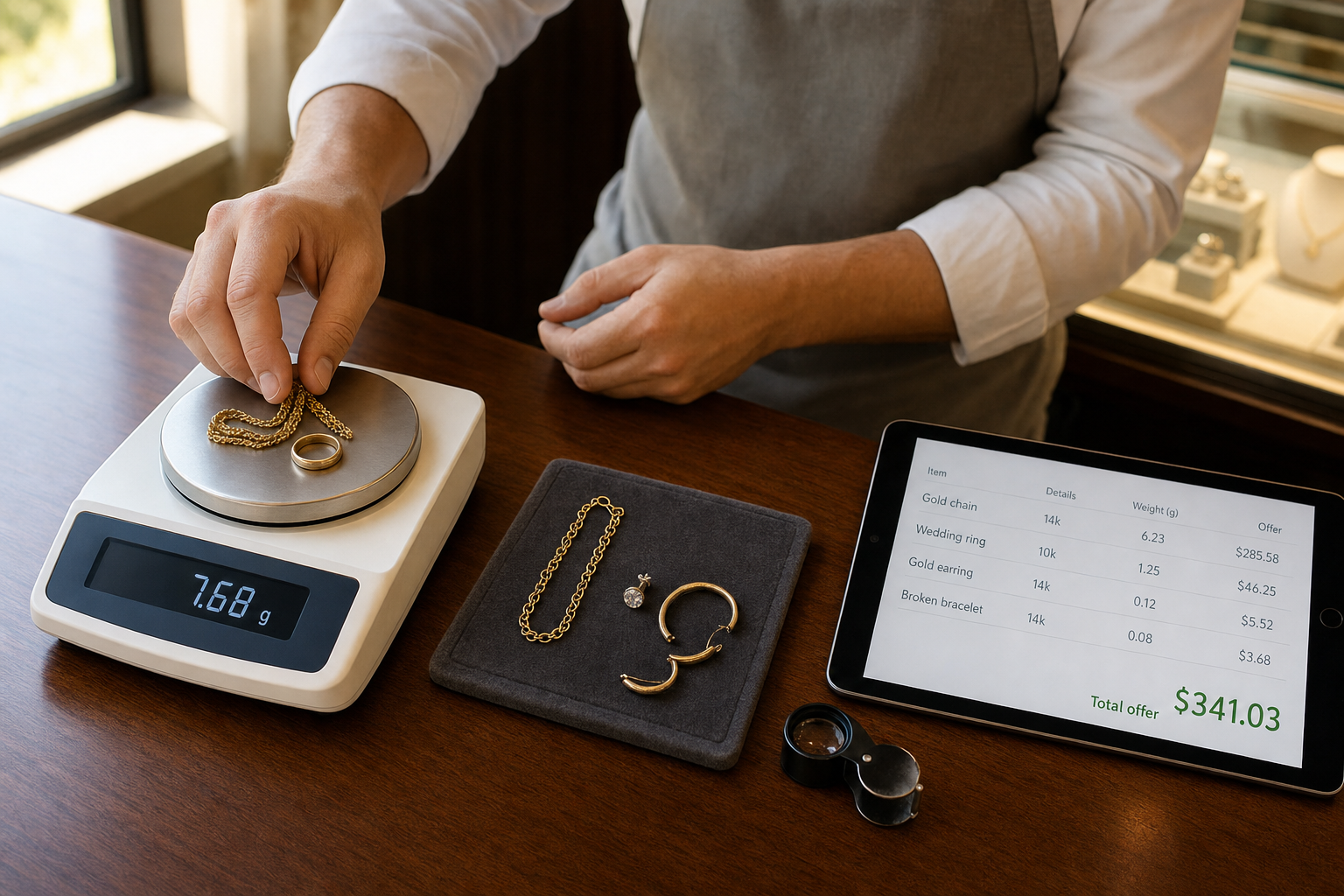
Old gold is one of the most profitable lines a small jeweler can run, and one of the most improvised. Most shops buy back on instinct: a price in someone's head, a number on a sticky note, a piece that sits on a tray for three weeks. Done with a routine instead, a buy-back takes ten calm minutes, leaves the seller feeling fairly treated, and turns into stock or a refiner batch by the end of the day.
This is the full guide for jewelers, and it covers both halves of the job. The first half is the counter routine: what to ask, how to test and weigh, how to price fairly, and what to document. The second half is the part most jewelers skip entirely: how to actively bring more gold across your counter, and how to turn a scrap transaction into a new customer and sometimes a new commission. It works the same in any country, in any currency, and at any gold price.
Should you buy gold from the public?
For most jewelers the answer is yes, but only on two conditions: you have a refiner relationship you trust, and you have a documented routine you follow every single time. The margin on scrap gold is steady and predictable, but it is rarely the real prize. The real prize is who walks through the door.
People who come in to sell gold are warm prospects. They are already standing at your counter with something valuable, and money is about to change hands. A jeweler who treats that moment as a service, not a transaction, regularly converts it into a sale, a repair, or a commission to remake the gold into something new. That is far more valuable than the few percent of margin on the metal itself.
The flip side: an undocumented, inconsistent buy-back is a liability, not a line of business. If you cannot price the same way for every customer and keep a clean record of every deal, do not start until you can. The rest of this guide, and the buy-back tools in Gem Logic, are about making that discipline effortless.
What to ask before the gold goes on the scale
The first two minutes are not about the gold. They are about the seller and what they actually want. A few short questions reframe the whole conversation and prevent the most common mistakes:
- Are you sure you want to sell? Some pieces carry sentimental value the customer hasn't fully thought through. Asking out loud protects them, and protects you from a regretful seller later.
- Where is the piece from? Inherited, your own, a gift, a workshop leftover. You are not interrogating, you are establishing provenance for your own records.
- Cash, store credit, or a trade-in toward a new piece? A trade-in or a remake is almost always worth more to the customer and more to you. Lead with it when it makes sense, before you ever talk about a cash figure.
- Do you have ID with you? Better to find out now than after you've made an offer and the deal stalls at the paperwork.
Create the seller as a customer record from the very first minute, not at the end. Two minutes of conversation here saves twenty minutes of friction later, and quietly tells the customer they have walked into a serious shop, not a pawn counter.
How to test and weigh old gold
Always test before you weigh. A weight on a piece of unknown purity is a number with no meaning, and customers can tell when you are guessing.
- Look first. Hallmark, purity stamp, country mark, maker's mark. A loupe and a clean cloth are all you need. If a piece has no mark and the seller doesn't know its purity, treat it as unknown until proven otherwise.
- Acid or electronic test for anything unmarked or doubtful. Test in a discreet spot. If it fails, say so plainly and offer to test the next piece. Never argue with the metal.
- Separate by purity and by metal before weighing. Group 9k, 14k, 18k, 22k and 24k separately, and keep white, yellow and rose apart if alloys differ. Mixed weighing is the single biggest source of pricing errors.
- Remove the parts that are not gold. Steel spring rings, clasps, watch pins, and stones in their settings. Either deduct an estimated weight, or for higher-value pieces take the stones out and weigh them separately.
- Use a calibrated 0.01 g scale, in front of the customer. Zero it before each item and let them watch the number. Visible weighing is half of why an offer feels fair.
The details an experienced jeweler checks that a checklist won't tell you
- Run a magnet over it first. Gold is not magnetic, but the clasps, springs and pins attached to it usually are. A quick magnet pass catches plated base metal before you waste time on the touchstone.
- Plated gold can pass a surface test. On a high-value piece, file a slightly deeper notch in a hidden spot and re-test, so you are reading the core and not the plating.
- Solder seams and chain clasps are often a lower karat than the body. On a heavy chain that difference is real money, in your favour or the customer's, so account for it instead of pricing the whole piece at the stamp.
- Read the stamp carefully. "Gold-filled", "rolled gold" and "GP" are not solid gold, however convincing the piece looks. When in doubt, test, don't trust the engraving.
How to price old gold fairly
The customer doesn't need to know your margin. They need to feel that the offer would have been exactly the same if their cousin had walked in five minutes earlier. That feeling comes from a formula you actually use, every time, for everyone.
For each line on the offer:
- Start from today's spot price for the metal, not last week's price you happen to remember.
- Convert spot to a price per gram for the actual purity of the piece (18k is 75% pure, 14k is 58.5%, 9k is 37.5%, and so on).
- Apply your buy-back margin. This covers refining, financing, the risk of a bad piece, and your time. Set it once per metal, then leave it alone.
- Round the total up to a clean number. A 1,864.62 offer becomes 1,870. Customers remember the gesture more than the cents.
In Gem Logic, the buy-back screen runs this formula automatically. You pick the metal, weigh the piece, and the line is priced from the live spot rate and your per-metal margin, with separate lines for metal, loose gems and finished pieces on a single purchase. A workspace setting rounds the total up so staff never calculate anything in their head at the counter.
The expert move is restraint: set the margin per metal once and never negotiate it per customer. Consistency is what makes a buy-back fair, and a reputation for the same honest number every time is worth more than the extra few euros you'd squeeze out of one deal. Show the breakdown on screen, weight, purity, spot, margin, total, and the offer feels fair even when the number is lower than the seller hoped.
What you must document when you buy gold from the public
Buy-back rules differ from country to country, and they change. Treat the local law as the floor, not the ceiling. As a working principle, every buy-back you make from the public should produce, on the day, a single record that contains:
- The seller's identity, captured from a photo of an official ID, not just typed in.
- A description of every piece, with weight, purity, and a photograph.
- The price paid per line and in total, with the spot rate used that day.
- The payment method (cash, transfer, store credit) and the date.
- Both signatures, seller and buyer.
- A holding period before the goods leave the shop or get melted, so the record can be reconciled if a question is raised.
In practice, this is where most jewelers slip. Paper forms get filed somewhere, photos live on a phone, and the customer record is created from memory two days later. By the time anyone needs to find the deal, the trail is already cold.
Gem Logic turns the documentation into the workflow itself. The ID is photographed onto the contact, both signatures are captured on a tablet at the counter, and the police book and any supporting documents are kept with the purchase, which moves through a clear quote, approved, paid status. Nothing is written twice, nothing is filed loose, and the routine is identical for every member of staff.
Resell or scrap: what to do with the gold you buy
Once a piece is paid for and documented, you have two paths. Wearable, on-trend pieces in good condition belong in your second-hand display, where the markup is far higher than the scrap value. Worn, broken, or out-of-fashion pieces go to the refiner.
The mistake is leaving the decision for "later". Pieces that sit unsorted on a tray for three weeks become a guessing game by the end of the month. Decide on the day. Resellable pieces become catalog items with their own SKU and photograph. Scrap pieces are bagged, labelled with the purchase reference, and weighed into a refiner batch you can reconcile later.
The same inventory discipline that runs your new stock should run your buy-back stock. One catalog, one reporting view, one source of truth, whether a ring came from a supplier or across the counter.
How to attract more gold sellers as a jeweler
Everything above assumes the gold walks in on its own. Most of it does, eventually. But buying gold is also something you can market, and it is one of the cheapest ways to get qualified people through the door. Unlike CRM or inventory features that you usually sell through paid ads, a buy-back offer reaches people who already have a reason to visit you, and money about to move. Here is how to bring more of it in.
Put the offer on your website
People search "where can I sell my gold near me" far more than you'd think. A clear "we buy your gold" page on your own site, with how it works and what to bring, captures that intent locally. If you don't have a site that's easy to update, that's exactly what your own Gem Logic website is for, and our team can build and design it for you.
Reach the customers you already have
Your warmest audience is the one you already sold to. Segment past customers in your CRM, then send a short, templated message through email management: gold is at a high, bring in old pieces for a free valuation this month. Because the email is tied to the customer record, every reply lands back on the right contact instead of getting lost in a separate inbox.
Sell the remake, not just the cash
The highest-value outcome of a buy-back is not a cash payout, it is a commission. A drawer of a grandmother's broken chains becomes a new ring the customer will actually wear. Offer to remake old gold into a custom creation: it keeps the sentimental value, carries a far better margin than scrap, and turns a seller into a long-term client. Track the whole project, brief, quote, deposit, photos, delivery, on one timeline.
Decide if it's worth it, then measure
Promotion is only worth it if you have the routine and the refiner relationship to back it up, otherwise you create a rush you can't process cleanly. Once you do, treat each campaign like any other: watch the metal-purchase report and your reporting to see how much gold came in, what it cost, and how many of those sellers came back as buyers. That last number is the one that tells you whether buy-back is a side line or a real channel.
Conclusion
Buying gold from the public is two skills, not one. The first is the calm, transparent, documented routine at the counter: ask the right questions, test before you weigh, price the same way for everyone, document as if you'll have to defend it, and sort the gold the same day. The second is treating buy-back as a service you actively promote, so the gold, and the customers attached to it, keep coming in.
Customers who sell to you are paying close attention. They watch the scale, they watch the screen, they watch how unhurried you are. Put a confident routine behind the counter and a clear offer in front of it, and a one-off transaction becomes a story they tell three friends, and that, more than the gold itself, is what makes buy-back a long-term line for the shop.
See how Gem Logic runs buy-back from offer to payout
Live metal pricing, ID and signature capture, a clean compliance trail, and the gold sorted straight into your catalog or your refiner batch.