
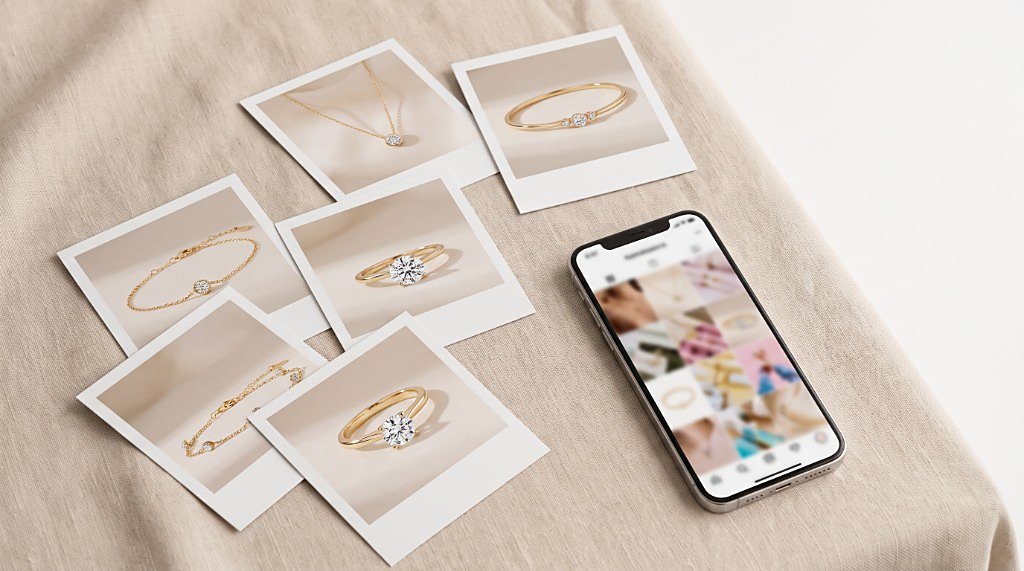
Pinterest is the platform most jewelry store owners know they should be using and consistently do not get around to. The reasoning is understandable: Instagram already takes time, social media in general feels like a treadmill, and adding another platform sounds like more work for unclear return.
The reality of Pinterest for jewelry retail is different from most other platforms, and understanding that difference is what makes it worth doing without requiring a significant ongoing time investment.
Pinterest is not a social media platform in the way Instagram or Facebook is. It is a visual search engine. People use it the way they use Google, to find ideas, to research purchases, to save things they want to buy later. When someone is planning a wedding and searches for engagement ring styles, they are on Pinterest. When someone wants anniversary gift ideas for a partner who loves jewelry, they are on Pinterest. When someone is decorating a home and wants jewelry that matches an aesthetic they are building, they are on Pinterest.
The content on Pinterest does not disappear after forty-eight hours the way an Instagram post does. A pin published today can drive traffic to a jewelry webshop two years from now, because it sits in search results and on boards where people find it through ongoing searches rather than through a feed that moves on immediately. This long shelf life is what makes Pinterest different from every other platform a jewelry store might use, and it is what makes a modest, consistent investment worthwhile over time even when the immediate results are hard to see.
This guide covers what Pinterest actually is for a jewelry store, how to set it up correctly, what to pin and how often, how to connect it to the webshop for direct traffic, and how to maintain a useful presence in under an hour per week once the initial setup is done.
Why jewelry is one of the best categories on Pinterest
Not every product category performs equally well on Pinterest. The platform favors visual, aspirational, occasion-driven content, and jewelry hits all three criteria more consistently than almost any other retail category.
Engagement rings are among the most searched topics on Pinterest globally. A person who has just gotten engaged, or whose partner is about to propose, opens Pinterest and searches for ring styles, wedding band combinations, bridal jewelry, and engagement announcement ideas. The volume of this search traffic is substantial, and it is ongoing year-round rather than seasonal in the way Instagram engagement content can be.
Gift inspiration is the second major category. Searches for birthday gift jewelry, anniversary gift ideas, Christmas jewelry gifts, and Mother's Day presents drive significant traffic to Pinterest boards and from there to the webshops linked from the pins. A customer who finds a piece through a gift search and clicks through to the webshop is a customer with clear purchase intent, not someone who happened to scroll past a post.
Style and aesthetic research is the third category. Customers who are building a personal jewelry style, who want to understand what works together, or who are looking for pieces that match a specific aesthetic use Pinterest as a reference library. Boards organised by metal, by style, or by occasion serve this research need directly.
The combination of these three use cases, proposal research, gift buying, and style development, means that jewelry content on Pinterest reaches customers at high-intent moments in the buying journey. The traffic it sends to a webshop is not casual browsing. It is research that is often close to a purchase decision.
Setting up a Pinterest business account correctly
The difference between a personal Pinterest account and a business account is significant for a jewelry store. A business account provides access to Pinterest Analytics, which shows which pins are driving traffic and saves, and enables Rich Pins, which automatically pull product information from the webshop into the pin itself.
Setting up a business account is straightforward and free. If the store already has a personal Pinterest account, it can be converted to a business account in the settings without losing existing boards or followers. If starting from scratch, creating a business account rather than a personal one from the beginning takes the same amount of time.
The profile should be complete before any pinning begins. The store name, a clear profile description that mentions the location and the type of jewelry sold, a profile photo that is either the store logo or a strong product image, and the website URL are the minimum. The website URL is important because it enables claiming the website, a verification step that unlocks Rich Pins and ensures that any pin saved from the store's website is attributed to the correct account.
Claiming the website involves adding a small piece of code to the site or uploading a verification file, a process that takes ten minutes with basic website access and is worth doing before anything else. Once the website is claimed, every image saved from the webshop by any Pinterest user automatically links back to the store and is attributed to the account.
Rich Pins pull the product name, price, and availability directly from the product page and display them on the pin. For a jewelry webshop, this means a pin showing a ring also shows the current price and whether it is in stock, without any manual updating. When the price changes or the piece sells out, the pin updates automatically. This is the most direct connection between the Pinterest presence and the webshop, and it works best when your website and stock already share one system so the data behind every pin is always accurate.
Board structure: the foundation of a useful Pinterest presence
Boards are how Pinterest organises content, and the board structure of a jewelry store's account is the first thing a new visitor sees when they land on the profile. A well-organised board structure makes the account useful to visitors and signals to the Pinterest algorithm what the account is about.
The most useful structure for a jewelry store combines product-focused boards with occasion-focused boards and aesthetic-focused boards. Each serves a different search intent.
Product-focused boards cover the main categories of the range: engagement rings, wedding bands, diamond jewelry, gold necklaces, earrings, bracelets, and so on. These boards capture search traffic from customers looking for a specific type of piece. A board titled "Diamond Engagement Rings" that contains a hundred pins from the store's range, alongside curated sources that show complementary styles, will appear in searches for engagement rings and drive traffic from customers in active research mode.
Occasion-focused boards capture gift intent: anniversary jewelry gifts, Mother's Day jewelry, Christmas jewelry ideas, birthday gifts for her. A customer searching for anniversary gift ideas who finds a board full of relevant pieces, linked back to the store's webshop, is a customer at a high-intent moment. The board does the work of connecting the search to the product.
Aesthetic-focused boards reflect the visual language of the store and serve the customer building a style reference rather than looking for a specific piece. A board titled "Minimal Fine Jewelry" or "Vintage-Inspired Gold Jewelry" speaks to a customer defining their taste, and a store whose aesthetic matches what they are building becomes the obvious place to shop when they are ready to buy.
One practical board that most jewelry stores overlook is a board specifically for the local area or for the store itself. "Jewelry Store in [City]" or "Our Collection" gives local customers a direct visual catalog of what the store carries, and it appears in local search results on Pinterest for customers specifically looking for a jeweler in the area.
Each board needs a title that uses the words customers actually search for, not the words the store uses internally. "SS25 Collection" is not a search term. "Gold Stacking Rings 2025" is. The board description should include a sentence or two with relevant keywords, written naturally rather than as a list. Pinterest uses these descriptions to determine which searches the board appears in.
What to pin and where to find the content
The content of a Pinterest presence for a jewelry store comes from three sources: the store's own images, content saved from the webshop, and curated pins from other sources that are relevant to the boards.
The store's own images are the most valuable pins because they link directly to the webshop and drive traffic that can convert to sales. Every product image on the webshop is a potential pin. Every lifestyle image produced for Instagram is a potential pin. Every behind-the-scenes photo from the workshop or the design process is a potential pin. The images already exist. Pinterest is a way to extend their reach and shelf life beyond the platforms where they were originally used.
For stores using Gem Logic's AI image tools, the styled lifestyle images and clean product images generated there are directly suitable for Pinterest. An image of a ring against a natural stone surface, generated from a product photo, pins well and drives engagement because it presents the piece in a context that Pinterest users respond to.
Content saved from the webshop, using the Pinterest Save button that can be added to product pages, allows the store to pin products directly from the product page with the price and availability automatically included through Rich Pins. This is the fastest way to build a product-focused board: spend twenty minutes going through the webshop and saving each product to the relevant board.
Curated pins from other sources fill the boards with additional content that makes them more useful to the visitor in research mode rather than actively looking to buy. A board about engagement rings that contains only pins from one store feels like an advertisement. A board that mixes the store's own pieces with complementary styles, gemological information, proposal ideas, and wedding jewelry inspiration feels like a genuine resource. Visitors spend more time on it, save more from it, and follow the account because it is useful to them.
The ratio of own content to curated content should shift over time as the store's own image library grows. A new account might start at thirty percent own content and seventy percent curated. A mature account with a full product range photographed and styled might be sixty to seventy percent own content. The balance matters less than the quality and relevance of everything on the board.
How often to pin and how to make it sustainable
The question most jewelry store owners have about Pinterest is how much time it actually requires to maintain. The honest answer is that the initial setup, creating boards, writing descriptions, and pinning the existing product range, takes a few hours spread over a week or two. After that, a sustainable maintenance routine for most independent jewelers is thirty to sixty minutes per week.
Pinterest rewards consistency over volume. An account that pins ten to fifteen items per day is less effective than one might assume, because Pinterest's algorithm is not primarily a recency feed. Pinning five to ten items several times a week, spread throughout the week rather than all at once, keeps the account active without requiring daily attention.
Scheduling tools eliminate the need to be on Pinterest every day. Pinterest's own scheduling feature, available within the business account, allows pins to be scheduled in advance. Sitting down once a week and scheduling the following week's pins takes thirty minutes and means the account stays active on days when the store is busy with other things.
Batch content creation makes this even more efficient. The same session used to photograph new products for the webshop and Instagram produces images that can be pinned the same day. The caption written for an Instagram post about a new piece can be adapted into a pin description in two minutes. Nothing needs to be created specifically for Pinterest. The content already being produced for other purposes is repurposed for a platform where it has a much longer useful life.
A practical weekly rhythm for most jewelry stores is to spend thirty minutes on Monday scheduling the week's pins, including new product images, one or two lifestyle images, and a handful of curated pins that fill out the boards. This routine, done consistently for six months, builds a presence that drives traffic without requiring daily attention.
Pin descriptions: the detail most stores get wrong
A pin without a description is a missed opportunity. Pinterest is a search engine, and the description is how the search engine understands what the pin is about and which searches to show it in.
A good pin description for a jewelry store is between one hundred and three hundred characters, written naturally rather than as a keyword list, and includes the specific details a searching customer would use: the metal type, the stone, the style, the occasion, and where relevant the location of the store. "18k yellow gold diamond solitaire engagement ring, classic four-prong setting, available for viewing by appointment at our jewelry store in [city]" gives the algorithm multiple relevant signals and gives the viewer the information they need to decide whether to click through.
The description should not read like a product specification. It should read like a recommendation from someone who knows the piece. "The kind of ring that works with everything and gets better with every year of wear" speaks to the customer's desire, not the product's attributes. The best descriptions combine the searchable specifics with a sentence or two that makes the reader want to see the piece in person.
Every board description, every pin description, and the profile description itself contribute to how the account appears in Pinterest searches. Writing these carefully at the setup stage, and updating them as the account grows, is the highest-leverage writing task in building a Pinterest presence.
Connecting Pinterest to the webshop and tracking what works
The commercial value of a Pinterest presence for a jewelry store is measured in website traffic and in sales that originate from Pinterest. Both are trackable, and tracking them is what makes it possible to understand which boards and which pin types are working and which are not. It all depends on pins that point to a webshop that always reflects your real stock and prices.
Pinterest Analytics, available in the business account, shows which pins are generating impressions, saves, and outbound clicks. Outbound clicks are the metric that matters most for a webshop: these are the customers who saw a pin and clicked through to the product page. A pin with ten thousand impressions and five outbound clicks performs differently from one with two thousand impressions and eighty outbound clicks. The second pin is driving real traffic. The first is being seen but not compelling enough to click.
Google Analytics or the analytics built into the webshop platform shows how much traffic is arriving from Pinterest and what those visitors do when they arrive. A customer who lands on a product page from a Pinterest pin and adds to cart is a direct conversion from the Pinterest investment. A customer who browses several pages and then leaves is still a warm lead who may return directly later. Treating Pinterest as one more channel in your weekly numbers keeps the effort honest.
The insight that most jewelry stores find when they first look at this data is that Pinterest drives more traffic than they expected, often more than Instagram for webshop visits, because the intent behind a Pinterest search is higher than behind an Instagram scroll. A customer who saves a ring on Pinterest has expressed a preference they can return to. A customer who likes a post on Instagram has expressed a momentary appreciation. The former is significantly closer to a purchase.
What Pinterest cannot do and where other channels still matter
Pinterest works best as a discovery and research platform. It is not where customer relationships are built, where the store's personality is communicated day to day, or where time-sensitive promotions are announced. These remain the domain of Instagram, email, and direct customer communication.
A customer who discovers a jewelry store through Pinterest, visits the webshop, and then follows the store on Instagram to stay in touch has moved through a natural funnel: discovery on Pinterest, relationship building on Instagram, conversion through the webshop or an in-store visit. Pinterest is the top of that funnel for a meaningful number of jewelry customers, particularly those doing research for significant purchases, and it feeds directly into the work of turning interest into booked appointments.
The practical implication is that Pinterest should be seen as a long-term traffic and discovery channel rather than a conversion tool that produces immediate sales. A store that sets up Pinterest in September and expects significant sales in October will be disappointed. A store that sets it up in September, maintains it consistently, and reviews the traffic data in March will typically see a meaningful and growing stream of webshop visitors that compounds over time.
Conclusion
Pinterest is the platform that rewards the jewelry store willing to invest a modest amount of time upfront and maintain a consistent but lightweight presence over the long term. The content it requires already exists in any store that photographs its products and produces images for other channels. The time it requires, once set up correctly, is thirty to sixty minutes per week. The return it delivers, search-driven traffic from high-intent customers doing active research, compounds over months and years in a way that no other social platform matches.
The stores that dismiss Pinterest because they cannot see the immediate return are the ones whose competitors are quietly building a presence that will drive engagement ring searches, anniversary gift clicks, and webshop visits for years to come. The effort required to compete is modest. The cost of not being there, for a category as visual and research-driven as jewelry, is real.
Key takeaways
Pinterest is a visual search engine, not a social media feed, which means content has a long shelf life and drives traffic from customers with active purchase intent rather than casual browsers. Setting up a business account, claiming the website, and enabling Rich Pins are the foundational steps that connect Pinterest directly to the webshop. Board structure should combine product-focused, occasion-focused, and aesthetic-focused boards, each with titles and descriptions that use the words customers actually search for.
Pin descriptions should include searchable specifics alongside a sentence that makes the reader want to see the piece. A sustainable weekly routine of thirty to sixty minutes, with content batched and scheduled in advance, maintains an active presence without daily effort. And Pinterest Analytics combined with webshop traffic data reveals which pins are driving real clicks, making it possible to focus effort on what actually converts rather than what gets the most saves.
Make every pin link to an accurate, up-to-date product page
A strong Pinterest presence drives traffic to the jewelry webshop that converts. See how Gem Logic's ecommerce platform connects to your product catalog so every pin links to an accurate, up-to-date product page. Try Gem Logic free for 14 days, or book a demo to see it in action.