
There is a customer who walks into a jewelry store every December with a clear intention and an impossible problem. They want to buy a meaningful gift for someone who loves jewelry, has strong opinions about what they wear, and would be quietly disappointed by the wrong choice. They do not know the recipient's ring size. They are not sure whether she prefers yellow gold or white gold. They know roughly what they want to spend but have no idea which specific piece to choose.
This customer does not need more options. They need a gift card.
Most independent jewelers treat gift cards as a fallback, something to offer when a customer cannot find what they are looking for. The stores that use gift cards well treat them as a product in their own right: something to merchandise, promote, and position as the thoughtful choice for a specific type of buyer rather than the default for an indecisive one.
A gift card sold today is guaranteed revenue, regardless of what the recipient eventually chooses. The recipient becomes a new customer, often spending more than the card's value when they come in to redeem it. And the store acquires a relationship with someone who may never have visited otherwise.
This guide covers how to set up gift cards correctly, how to merchandise and promote them through the year, how to use them as store credit and value vouchers, and how to make them a genuine revenue driver rather than an administrative afterthought.
Why gift cards work particularly well for jewelry stores
Gift cards work in every retail category, but they work especially well in jewelry for reasons that are specific to the category rather than generic to retail.
Jewelry purchases are personal in a way that most gifts are not. A piece of jewelry carries aesthetic judgments about color, style, weight, and formality that vary significantly from person to person. Getting these judgments right for someone else is genuinely difficult, and the consequence of getting them wrong, a piece that sits unworn because it does not match the recipient's taste, is a worse outcome than a gift card that lets the recipient choose for themselves.
The jewelry buying occasion is often high-stakes. An anniversary, a significant birthday, a Christmas gift for a partner: these are not casual purchases, and the buyer feels the weight of choosing correctly. A gift card from a specific jewelry store the recipient loves or has expressed interest in is not a lazy choice. It is a considered one that says "I know you have taste and I trust you to choose what you love."
The redemption dynamic is also favorable for jewelers. A customer who walks in to redeem a gift card arrives with a predetermined budget and no price sensitivity in the usual sense: the money has already been spent, and the question is simply how to spend it. These customers are often receptive to spending above the card value when they find something they really want, which they frequently do. A gift card for one hundred and fifty euros regularly results in a transaction of two hundred and fifty or more.
And unlike stock, gift cards carry no inventory risk. They do not need to be stored, do not depreciate, and do not become less relevant if a trend shifts. A gift card created in January is as useful in March as it was when it was sold.
Setting up gift cards correctly from the start
A gift card system that works in practice requires a few decisions made correctly at the outset, before the first card is sold.
The code format is the first decision. Every gift card should have a unique, auto-generated code that is easy to look up at the counter and immediately identifiable as a gift card rather than a product barcode or an order number. A prefix specific to the store, "GC-" followed by a series of letters and numbers, makes gift card codes instantly recognizable and reduces the chance of confusion at the register. Gem Logic generates unique codes automatically with a configurable prefix, so the format is consistent across every card issued.
The question of expiration dates deserves thought before it is set. An expiration date protects the store against liability for unused balances sitting on the books indefinitely, but an expiration that is too short, six months or less, creates customer friction and can generate resentment when a recipient discovers their card has expired before they used it. One to two years is a reasonable standard for most jewelry stores: long enough that a recipient has genuine flexibility, short enough to limit the open liability.
The denomination range should cover the gift budgets that are realistic for the store's customer base. A store whose typical purchase is between two hundred and a thousand euros should have gift cards available at a range of amounts, perhaps fifty, one hundred, one fifty, two hundred, and five hundred as standard denominations, with the option to create a card for any custom amount for customers who want to give a specific sum. Having pre-created cards at standard denominations ready at the counter reduces the friction of the purchase for the customer who wants to buy quickly.
Balance tracking needs to be real-time and accessible at the register without a separate system. A customer who asks how much is left on their card should receive an immediate, accurate answer without the staff member needing to call anyone or check a spreadsheet. Gem Logic tracks every gift card balance in real time, with a complete transaction history showing every payment made and the remaining balance after each one. Looking up a card by its code takes seconds.
Bulk creation: preparing for peak gifting occasions
The occasions that drive gift card sales in a jewelry store are predictable: Christmas, Valentine's Day, Mother's Day, anniversaries, and significant birthdays. Preparing for these occasions means having cards ready before the buying surge arrives, not creating them one by one as customers ask.
Bulk gift card creation allows a store to prepare a batch of cards at a standard denomination ahead of a peak occasion, each with its own unique code, ready to sell or display at the counter. A display of twenty pre-made gift cards at a hundred and fifty euros each, placed near the counter in the week before Christmas, sells without any active promotion because the customer who needed exactly that solution has just found it without having to ask. It is one of the simplest wins in the whole holiday preparation checklist.
Gem Logic supports bulk creation of gift cards with the same balance, currency, and expiration date, each receiving its own unique code automatically. A batch of fifty cards for a holiday promotion takes minutes to create and can be printed as professional PDF documents ready for display or distribution.
Corporate gift programs are an extension of this. A local business looking for client gifts or staff rewards is a customer who might buy twenty gift cards at once. A real estate agency, a law firm, or a financial services company that wants to give clients a premium gift at the end of the year is a different kind of customer from the individual buyer, but the gift card is the product that serves them. A store that proactively approaches a handful of local businesses in October with a corporate gift proposal, offering custom denominations and professional presentation, can generate meaningful volume outside the normal retail channels.
Merchandising gift cards in store: making them visible and easy to buy
The most common reason gift cards underperform in a jewelry store is not that customers do not want them. It is that customers do not see them, or see them too late in the visit to act on them.
A gift card display near the counter is the minimum standard. Customers who have browsed the store and not found exactly what they wanted will often see a gift card display at the counter and recognize it as the solution they were looking for. The display does not need to be elaborate: a small acrylic stand with a few printed cards and a brief description of denominations available is sufficient. What matters is that it is visible at the natural decision point of the customer journey, which is the counter.
For peak occasions, the gift card display should be more prominent. A dedicated display in the window or at the entrance in the week before Christmas, Valentine's Day, and Mother's Day captures the customer who comes in specifically looking for a gift and has not yet committed to a specific type of product. A customer who sees a well-presented gift card display before they start browsing may decide immediately that this is the right solution, saving them the effort of choosing and giving the store a straightforward, high-margin sale.
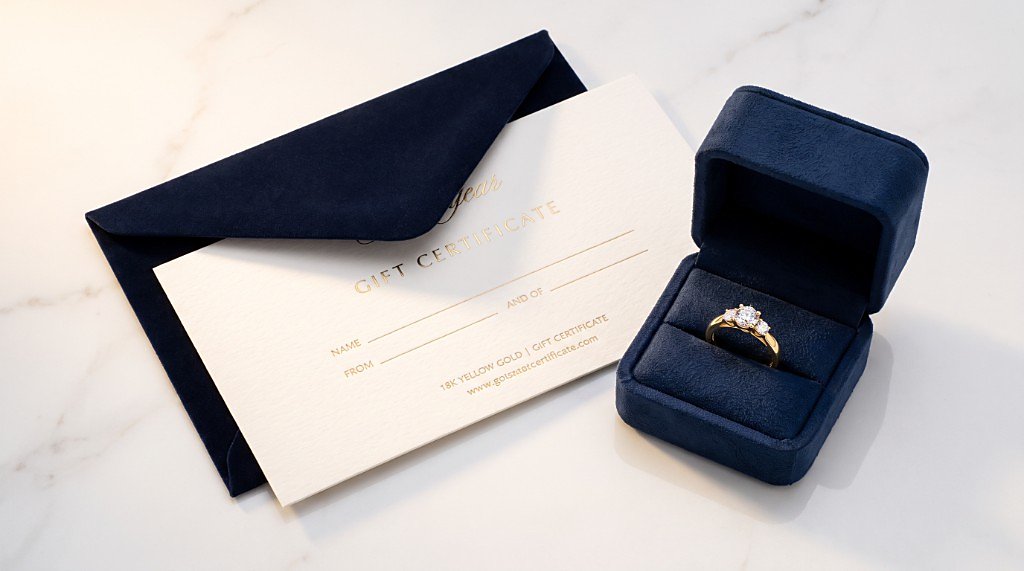
The packaging of the gift card matters more than most stores give it credit for. A gift card handed over as a printed piece of paper in a plain envelope is a different experience from a gift card presented in a small branded envelope or a simple card holder with the store's logo. The recipient's first impression of the store is formed partly by how the gift card is presented, and that impression determines how they feel when they arrive to redeem it. A modest investment in branded presentation material for gift cards pays back in the quality of the first impression it creates with a new customer.
Gem Logic generates professional, printable gift card PDFs in the customer's language, including the unique code, balance, expiration date, and store branding. The document is ready to hand over as a gift without any additional design work.
Gift cards as store credit and value vouchers
Beyond the standard gift card use case, gift cards serve a second practical function in a jewelry store: as store credit for situations where an immediate cash payment is not the right resolution.
A customer who sells old gold to the store leaves with either cash or, if the store chooses to offer it, a value voucher that keeps the credit within the store. A customer who returns a piece for an exchange and the replacement piece is slightly less expensive than the original can receive the difference as store credit rather than a cash refund. A customer who wins a store promotion or receives a loyalty reward can receive it as a gift card that brings them back for their next visit.
Each of these situations is a version of the same commercial logic: keeping value within the store rather than paying it out in cash. A customer who receives a hundred-euro store credit voucher after selling old gold is a customer with a reason to return and spend at least that amount. The store has acquired that customer's next purchase before they have even decided what to buy.
Gem Logic handles this use case natively: when a customer has a negative outstanding balance, for example from a gold purchase, the amount can be converted into a gift card that functions as a value voucher for future purchases. The balance is tracked in the same system as standard gift cards, with the same real-time balance visibility and transaction history.
Promoting gift cards through email and social media
A gift card that is only available in store is leaving significant revenue on the table. Customers who are planning a gift in advance, who are not near the store, or who decide to buy a gift at ten at night when the store is closed need a way to purchase online, or at minimum a way to know that gift cards are available so they can come in.
Email is the most direct channel for gift card promotion. A standalone email about gift cards in the weeks before each major gifting occasion, with clear information about denominations, how to purchase, and what the card can be used for, consistently converts customers who were already thinking about a gift for someone. The email does not need to be long or elaborate. A clear subject line, a brief explanation of why a gift card from this specific store is a thoughtful choice, a list of available denominations, and a call to action is sufficient.
The timing of gift card emails matters. Too early and the customer is not yet in gift-buying mode. Too late and they have already decided on something else. Two to three weeks before a major occasion is the sweet spot for most jewelry store gift card promotions, with a follow-up one week before for customers who have not yet acted.
Social media posts about gift cards perform well when they are framed around the problem they solve rather than the product itself. "Not sure what to get someone who has very specific taste in jewelry? A gift card lets them choose exactly what they love" speaks to a real customer situation. "Gift cards available in store" does not. The first post invites the reader to see themselves in the scenario. The second is an announcement that requires no action. The same principle applies wherever you post, including the Pinterest and Instagram content that reaches gift buyers in research mode.
The gift card redemption experience: making the first visit count
A customer who arrives to redeem a gift card is a new customer whose first real experience of the store is about to happen. The redemption experience determines whether they become a returning customer or a one-time visitor.
The most important thing the staff member can do at the start of a gift card redemption visit is find out who gave the card and what occasion it was for. This information shapes the entire interaction. A customer who received a gift card for their anniversary is in a different mindset from one who received it for a birthday or a personal achievement. Knowing the context allows the staff member to frame the experience around the occasion rather than treating it as a generic shopping trip.
The gift card balance should be visible to both the staff member and the customer without any awkwardness about asking. Confirming the balance at the start of the visit sets clear expectations and allows the customer to browse with confidence knowing exactly what they have to spend. A customer who is not sure of their balance will unconsciously avoid pieces that might exceed it, which often means they stay below the card value rather than spending above it.
The upsell opportunity in a gift card redemption visit is real but needs to be handled without pressure. A customer who is drawn to a piece that costs more than their card balance is a natural candidate for spending the difference, and most will do so happily when the piece is right. The invitation to consider something above the card balance should come from the customer's own attraction to the piece, not from a staff member pushing them toward more expensive options. The staff member's job is to help the customer find what they love. The spending above the card value follows naturally when they do.
Recording the gift card redemption visit against the customer's CRM profile creates the starting point for a new relationship. This customer's preferences, the piece they chose, and any information shared during the visit are now in the system and can inform the next interaction, whether that comes from the store reaching out ahead of an occasion or the customer returning on their own. It is the moment a one-time visit becomes customer data you can sell from for years.
Tracking gift card revenue correctly in reporting
Gift card revenue requires specific handling in the store's financial reporting because the timing of the revenue recognition is different from a standard product sale.
When a gift card is sold, the store receives cash but has not yet delivered a product. The gift card represents a liability: the obligation to provide goods or services of that value at some future point. It is not product revenue until the card is redeemed.
This distinction matters for understanding the store's performance accurately. A November that includes twenty gift card sales looks more profitable than it is if the gift card sales are counted as product revenue, because the cost of goods for those sales has not yet been incurred. When the cards are redeemed in January and February, the cost of goods appears without the corresponding revenue, which makes those months look worse than they are.
Gem Logic separates gift card turnover from product turnover in all reports, so the financial picture of any period is accurate. Gift card sales appear as their own line in the turnover summary, distinct from actual product sales, so the store's real trading performance is always visible without confusion between the two. It is one more reason the weekly numbers you track stay meaningful through the gifting season.
Conclusion
A gift card is not a fallback for when a customer cannot find what they want. It is a product that solves a real problem for a specific type of buyer, brings new customers into the store, generates guaranteed revenue at the point of sale, and creates a redemption visit that, handled well, starts a new long-term customer relationship.
The stores that use gift cards well are not the ones with the most elaborate gift card programs. They are the ones that make gift cards visible and easy to buy, promote them at the right moments through the year, present them in a way that reflects the quality of the store, and treat every redemption visit as the first chapter of a new customer relationship rather than the conclusion of someone else's Christmas shopping.
The infrastructure required is modest. A system that creates and tracks gift cards without a separate tool, a display that makes them visible at the counter, a promotion plan built around the gifting occasions that drive the most sales, and a redemption experience that gives new customers a reason to come back.
Key takeaways
Gift cards work particularly well in jewelry because the category is personal and taste-specific, making them a genuinely thoughtful choice rather than a lazy one. Setting them up correctly requires decisions about code format, expiration dates, and denominations made before the first card is sold. Bulk creation before peak occasions ensures cards are ready to sell without friction when demand is highest. Merchandising them visibly at the counter, with better presentation near the entrance for peak occasions, converts customers who would otherwise leave without a purchase.
Gift cards double as store credit and value vouchers for gold buybacks, exchanges, and loyalty rewards, keeping value within the store. Email promotion two to three weeks before major gifting occasions reaches customers at the right moment. And the redemption visit is a new customer acquisition opportunity that should be treated as the beginning of a relationship, not the end of a transaction.
Turn gift cards into a year-round revenue driver
Gem Logic creates, sells, and tracks gift cards from the same system as your sales, inventory, and customer records, with real-time balance tracking, professional printable PDFs, and reporting that separates gift card revenue from product sales. Start your 14-day free trial, or book a demo to see gift cards in action.