
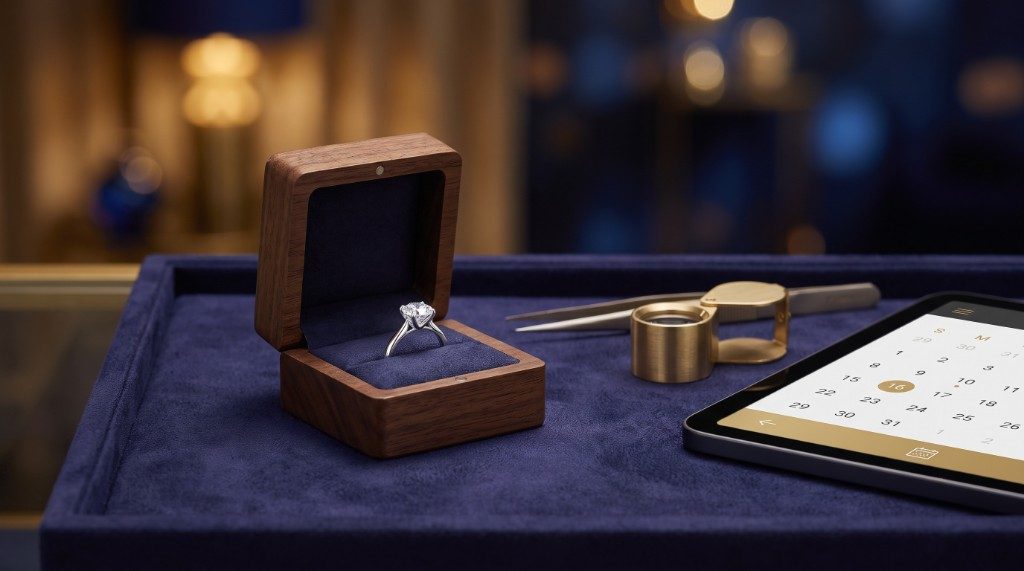
Walk into any independent jewelry store in November and ask the owner when their busiest period for engagement rings is. Almost every one of them will say Christmas, New Year, and Valentine's Day. They are right. What fewer of them can tell you is exactly how many engagement ring consultations they had booked in advance for those weeks, versus how many walked in hoping for a ring without an appointment, without a clear budget, and without enough time to do the purchase justice.
The difference between a jewelry store that has a good engagement season and one that has a great one is rarely the quality of the stock or the skill of the staff. It is preparation. The stores that fill their calendars between October and February are the ones that started building toward the season in September, that made booking easy before the rush arrived, that reached out to customers who had signaled interest months earlier, and that treated every consultation as a scheduled appointment rather than a walk-in transaction.
This guide is for independent jewelers who want to approach engagement season with a plan rather than a hope. It covers how to prepare the collection and the team, how to fill the calendar with high-intent appointments, how to market the store during the season without competing on price, and what to do after the proposal to turn an engagement ring sale into a long-term customer relationship.
Understanding the shape of engagement season
Engagement season is not one peak. It is a series of peaks with distinct buying profiles, and understanding the shape of it allows a jeweler to prepare differently for each moment rather than treating the whole period as one undifferentiated rush.
The Christmas and New Year period, roughly the two weeks before Christmas through to the first week of January, is the highest volume moment for proposals in most markets. The combination of family gatherings, romantic occasion, and the symbolic weight of a new year makes this the most concentrated proposal window of the year. Buyers in this window are often working with tight timelines: they want to propose at Christmas dinner or on New Year's Eve and they are shopping in November or early December. The pressure of the deadline, combined with the emotional significance of the occasion, makes them high-intent but potentially stressed. A store that can offer a calm, unhurried consultation and a clear path to a ring they love within the timeline they need converts this customer well.
Valentine's Day, the fourteenth of February, is the second peak and has a different buyer profile. The timeline pressure is similar but the occasion is slightly less formal. Some Valentine's proposals are carefully planned. Others are more spontaneous, driven by the occasion itself rather than a long-standing intention to propose. The store that captures the carefully planned Valentine's buyer in January, through an appointment booked well in advance, serves them better than the one that relies on walk-in traffic in the days before the fourteenth.
The shoulder periods, October and November before Christmas, and the weeks between New Year and Valentine's Day, are where the most considered buyers shop. These are the customers who are not working to a specific proposal date yet, who want to take their time, explore options, and make the right choice without pressure. They are also the customers most likely to spend more, because they are not in a hurry and they can take the time to understand the difference between two stones, two settings, or two metals. Reaching these customers before the peak is one of the most valuable things a jewelry store can do in the lead-up to engagement season.
Preparing the collection: what engagement season buyers actually want
The most common mistake in preparing for engagement season is stocking more of what the store already carries rather than thinking carefully about what the specific customer coming in for an engagement ring is looking for.
Engagement ring buyers in most independent jewelry markets are looking for three things: a stone they can feel good about, a setting that reflects the partner's taste, and a price they can justify. None of these are simple, and a store that can guide a customer through all three confidently, with the right options at each decision point, will close more consultations than one that presents a good range but leaves the customer to navigate it alone.
The stone decision is increasingly complex for today's engagement ring buyer. Natural diamonds remain the dominant choice, but lab-grown diamonds are a genuine consideration for a growing proportion of buyers who are either budget-conscious or ethically motivated, or both. A store that can have a clear, honest conversation about the differences, backed by the right certificates, without steering the customer toward the more profitable option at the expense of the right recommendation, builds trust that converts and creates customers who refer.
The setting decision is where personal taste matters most, and where a store's range needs genuine breadth. Solitaires in different proportions, halo settings, pavé bands, tension settings, vintage-inspired designs: the customer who comes in with a picture saved on their phone of something they saw on Instagram needs to find something close to it, or needs to be shown why something else achieves the same feeling better. A store that carries only one aesthetic will lose every customer whose partner's taste falls outside it, which is exactly where a custom creation can turn a near miss into a sale.
The price decision is rarely about finding the cheapest option. It is about feeling confident that the money spent was the right amount for what was received. A customer who spends more than they planned and feels good about it is a customer who tells people about the store. A customer who spends exactly their budget and feels uncertain about whether they made the right choice is a customer who quietly wonders if they could have done better elsewhere.
Filling the calendar before the peak arrives
The highest-value thing a jewelry store can do in September and October is convert the customers who are already thinking about an engagement ring into scheduled consultations before the November and December rush makes appointments scarce.
The customers who are thinking about it are already signaling. They liked an engagement ring post on Instagram. They visited the webshop and spent time on the engagement ring category. They came into the store in summer and looked at rings without committing. They are a friend of a customer who got engaged last year and mentioned they were thinking about it. Each of these signals is a reason to reach out, gently and without pressure, and invite them to book a consultation before the season gets busy.
For existing customers in the CRM who match the profile, a personal message in September or October is a low-cost, high-conversion outreach. Not a promotional email about engagement rings, but a personal note from the store: "We are starting to see a lot of interest in the lead-up to the holiday season and our consultation slots are filling up. If you have been thinking about it, now is a good time to come in without the rush." This converts because it is specific, timely, and personal rather than generic.
For new customers who have not yet been in the store, the job is to make finding the store and booking a consultation as easy as possible. A Google Business Profile that lists engagement ring consultations as an available appointment type appears in local search results when someone searches for a jeweler in the area. A website that features engagement rings prominently with a clear booking call to action converts browser traffic into consultation bookings. An agenda with online booking through Calendly allows a customer to pick a slot at eleven at night when they have finally decided to act, without waiting to call during opening hours.
The consultation: what happens in the room determines the sale
An engagement ring consultation is the highest-stakes customer interaction most jewelry stores have. The customer is nervous. They are spending more than they have ever spent on a gift. They are trying to make the right choice for a person who is not in the room. And they may have limited knowledge about diamonds, metals, and settings.
The store that handles this well does three things. It creates a setting that feels private and unhurried. It asks questions before it shows options. And it presents choices in a way that builds confidence rather than creating overwhelm.
Privacy matters more for engagement ring consultations than for almost any other retail interaction. A customer discussing budget and asking basic questions about diamond quality in front of other customers in the store is not comfortable. A consultation area, even a modest one, changes the dynamic entirely. The customer relaxes, takes their time, and engages more honestly with both the options and the price conversation.
Questions before options is a principle that is counterintuitive for most retail environments, where the instinct is to show the product immediately. For an engagement ring, it is essential. Before a single ring is removed from the case, understanding the partner's style, their daily life, whether they wear jewelry regularly, what metal they tend to wear, whether they have expressed any preferences: all of this shapes which options are shown and in what order. A customer who is shown the right three options, chosen based on real information, makes a decision faster and with more confidence than a customer who is shown twenty options chosen based on nothing.
After the consultation, a follow-up matters. A customer who did not commit on the day is not a lost sale. They are a customer who needs a little more time or a little more information. A personal follow-up three to five days later, referencing what they looked at and offering to answer any questions, converts a meaningful proportion of these undecided customers without any additional pressure.
Gem Logic's agenda allows notes to be attached to every appointment, so the staff member who did the consultation and the one who handles the follow-up are working from the same information rather than starting from memory.
Marketing during engagement season: presence over promotion
The instinct during a peak season is to run promotions: a discount, a complimentary gift with purchase, a free engraving offer. For an engagement ring, this instinct is largely counterproductive.
An engagement ring is not a category where price promotions drive decisions. A customer choosing a ring for a proposal is not looking for the cheapest option. They are looking for the right option, and a store that signals discount is not signaling the quality and trust that an engagement ring purchase requires.
What works instead is presence: making the store visible and credible at every point in the customer's research process, before they have decided where to go.
Content that educates converts engagement ring buyers better than content that promotes. A guide to choosing an engagement ring, published on the website and shared through social media, reaches customers who are in research mode and positions the store as the expert worth consulting. A post explaining the difference between different clarity grades, or comparing two settings that are currently popular, gives the customer useful information and puts the store's name in their head while they are still deciding.
Instagram and Pinterest are where a disproportionate number of engagement ring buyers do their visual research. A consistent presence on both platforms, showing the store's range in styled photography with context and story, means the store is part of the visual landscape the customer has been building before they ever walk through the door.
Local SEO is the most underused marketing channel for independent jewelers during engagement season. A customer who searches "engagement ring jeweler" followed by their city name is a buyer who is actively looking for a store. A Google Business Profile that is complete, current, and has recent positive reviews appears prominently in these searches. A website with a page specifically optimized for engagement rings in the local area captures search traffic that would otherwise go to a chain or a competitor.
Appointment types that fill the engagement season calendar
Not every interaction during engagement season is a full consultation. Offering a range of appointment types, each with a clear purpose and a clear length, makes the calendar easier to fill and easier to manage.
- A thirty-minute ring exploration session works well for customers who are early in the process and want to understand the options without committing to a full consultation. This appointment has a low barrier to booking: the customer does not need to have a budget or a timeline. It is simply a chance to see what is available and ask basic questions.
- A sixty-minute engagement ring consultation is the core appointment type for customers who are ready to look seriously and potentially decide. This is the appointment that requires the private setting, the question-first approach, and the personal follow-up.
- A fifteen-minute partner ring sizing appointment is a practical appointment that captures a specific need: the buyer has made their decision and needs the partner's size confirmed before placing the order. This appointment is easy to book, quick to complete, and creates a natural additional touchpoint with the customer in the days before the proposal.
- A resize and collection appointment, scheduled for after the proposal, allows the newly engaged partner to come in, have the ring sized properly, and see the store for the first time as a customer in their own right. This appointment plants the seed for the wedding band relationship that follows.
Gem Logic's agenda supports multiple appointment types with different lengths and purposes, each visible to the whole team and connected to the customer record. Online booking through the Calendly integration allows customers to self-book the right appointment type without a phone call.
After the proposal: the relationship that starts with the ring
The engagement ring sale is not the end of the relationship. For a store that handles it well, it is the beginning of a customer relationship that extends through the wedding bands, the first anniversary gift, the push present, and eventually the jewelry the couple buys for decades.
The steps immediately after the proposal are where this relationship is either established or lost.
A personal congratulations message, sent when the customer comes in for the resize or the first post-proposal visit, costs nothing and means a great deal. The customer has just had one of the most significant moments of their life. A jewelry store that acknowledges it personally, rather than treating the return visit as a routine transaction, becomes part of the story.
The wedding band conversation should begin at the first post-proposal visit, but gently. The couple is still celebrating the engagement. A brief mention that the store would love to help with the bands when they are ready, with an invitation to come back together when the time feels right, plants the seed without pressure. A follow-up in the spring, when most couples are beginning to think seriously about wedding planning, is well-timed.
A care and cleaning invitation, offered at the six-month or one-year mark, brings the couple back into the store and creates a natural occasion to show them what is new. The ring they chose a year ago is still the center of the relationship, and a store that helps them keep it beautiful is a store they trust for the next significant purchase.
All of this follow-up is only possible if the information is in the system. The purchase date, the partner's details, the ring size, the occasion: all of the customer data recorded in the CRM and accessible to whoever handles the next interaction, whenever it happens.
A practical engagement season preparation timeline
The engagement season preparation that makes a real difference is not done in November. It is done in September and October, when there is still time to build momentum before the peaks arrive.
In September, review the engagement ring range and identify gaps. Are there options at each price point the target customer is likely to be considering? Is there a range of settings that covers the main aesthetic preferences in the local market? Are there both natural and lab-grown diamond options for customers who want the conversation?
Also in September, set up or review the booking system. Is online booking available and easy to find on the website and Instagram bio? Are the appointment types clearly defined with accurate time slots? Are confirmation and reminder automations active?
In October, begin the outreach to existing customers who match the profile. A personal message to customers who have shown interest, or whose purchase history suggests they are at the right life stage, is the highest-return marketing activity of the pre-season period.
In October and November, produce and schedule the content that will run through the season. Educational posts, styled photography of key pieces, behind-the-scenes content from the consultation process: building this bank in advance means the social presence is consistent through the peak weeks without requiring daily creative effort during the busiest trading period of the year.
From November through February, focus on converting the consultations. Every customer who books is a high-intent prospect. The conversion rate from a well-run consultation in a private setting with a knowledgeable staff member is significantly higher than from a walk-in interaction. The calendar filled in advance is the infrastructure that makes this conversion rate possible.
Conclusion
Engagement season is the most commercially significant period in the calendar for most independent jewelry stores. The stores that approach it with a plan, that fill their calendars before the peaks arrive, that run consultations that convert because they are prepared and unhurried, and that follow up in ways that turn a ring sale into a decade-long customer relationship, consistently outperform the ones that treat it as a busy period to survive rather than an opportunity to build.
The preparation is not complicated. It is a clear collection, an easy booking process, a targeted pre-season outreach, a consultation format that puts the customer at ease, and a follow-up habit that keeps the relationship alive after the proposal.
None of it requires a large marketing budget or a large team. It requires starting in September rather than November, and treating every engagement ring consultation as the beginning of something rather than the end of a transaction.
Key takeaways
Engagement season has multiple distinct peaks, each with a different buyer profile: the time-pressured Christmas and New Year buyer, the Valentine's Day buyer, and the more considered shoulder-period buyer who shops in October and November and often spends more. Filling the calendar before the peak means reaching out to warm prospects in September and making online booking easy to find and use.
The consultation format matters as much as the range: privacy, questions before options, and a personal follow-up convert better than a well-stocked floor and a walk-in process. Marketing during engagement season works best through education and presence rather than promotion and discounting. And the engagement ring sale is the beginning of a customer relationship that extends through wedding bands, anniversaries, and decades of significant purchases, if the follow-up is consistent and the customer data is in the system.
Fill your engagement season calendar with the right customers
Gem Logic's agenda fills your calendar with online booking, automated reminders, and every appointment connected to the right customer record. The CRM keeps the relationship alive long after the proposal. Start your 14-day free trial, or book a demo to see both in action.