
Most jewelry store managers spend the first hour of the day reacting. A staff member is late, a customer rings about a repair, an order has not arrived, the till looks off by twenty euros. By the time the door is unlocked to the public, the manager is already behind, and the day never quite catches up.
A short, fixed routine fixes most of that. Fifteen minutes, every morning, in the same order, before the first customer walks in. Not heroic, just consistent. Below is the routine we see working in well-run boutiques, broken into four blocks of three to four minutes each, plus a few notes on the tools that make it possible.
Minutes 1 to 4: yesterday closed cleanly
You cannot run today calmly until you know yesterday is finished. Coffee in hand, sit down with the dashboard before anyone else arrives.
- Cash and payments reconciled. Total in the till matches the daily report. Card terminal and online payments matched against sales. Any discrepancy gets a one-line note now, not a hunt at the end of the month.
- Yesterday's number, in context. Total sales, average ticket, number of transactions, compared to the same weekday last week. You are not making decisions yet, you are just setting the temperature.
- One thing to fix. A returned item, a refund pending, a quote that should have been signed by now. Note it on the day's plan.
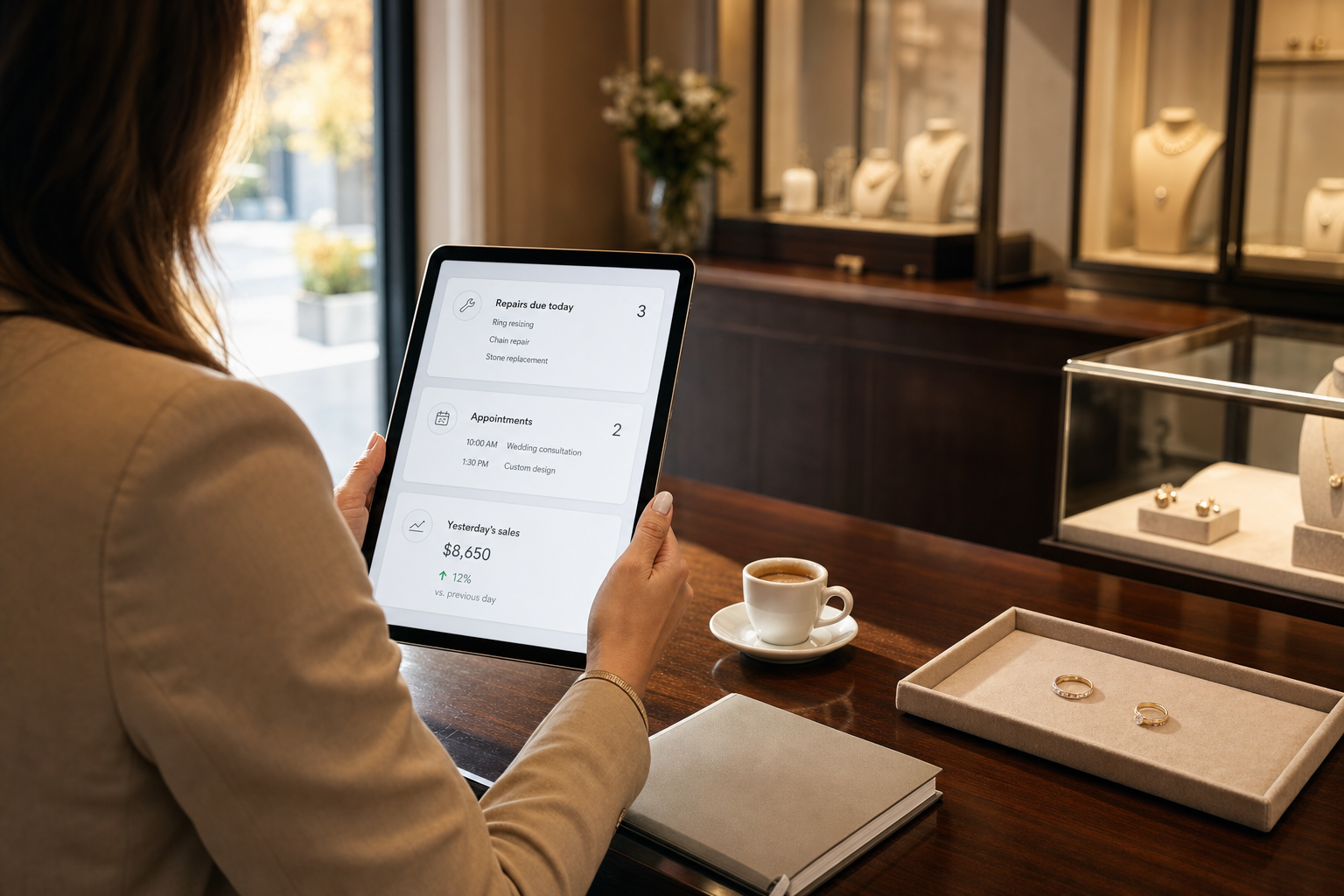
With a proper reporting view, this whole block is two clicks. With a notebook and a memory, it is fifteen minutes on its own.
Minutes 5 to 8: what was promised today
Every commitment your shop made to a customer for today, in front of you on one screen. The goal is no surprises at the counter.
- Repairs due today. Are they actually finished? Are they in the right tray, with the customer's name and reference visible? If anything has slipped, the customer gets a friendly message before they call you.
- Custom orders and supplier orders due today. Has the piece arrived? If not, do you need to call? An expected delivery that is silent at 9am is rarely going to be on time at noon.
- Quotes that expire today. One nudge, sent now, is worth ten chases next week.
Four minutes here saves you from the worst kind of moment, the customer standing at your counter expecting something you do not have.
Minutes 9 to 12: today's diary
Now look at what is actually scheduled. Treat the diary as a real document, not a polite suggestion.
- Customer appointments. Wedding consultations, ring-size measurements, VIP viewings, repair pickups. For each one, the customer's record should be open in your head before they arrive: their last purchase, their style, their budget, what was promised last time.
- Supplier and partner visits. A rep dropping off a new collection at 11am means someone needs to be free. Block it now.
- Internal blocks. Stock check at 3pm, training session at 5pm, social media post to schedule at lunch. If it is not on the diary, it will not happen.
A shared team agenda where appointments are linked to the customer's record turns this from a memory exercise into a thirty-second scan.
Minutes 13 to 15: the floor and the team
Step out from behind the desk. The last three minutes are about what your customer will actually see and feel today.
- The window and the displays. Lights on, glass clean, no empty trays, no fingerprints. The first impression of the shop is set before anyone speaks.
- The team huddle. Sixty seconds, standing up. Yesterday's number. The two or three customers expected today. The one piece you want everyone to know about, in stock or just arrived. Any blocker.
- The day's one priority. Not five, one. Stated out loud. Today we close the dead-stock review. Today we call back every quote from last week. Today we finally photograph the new collection. The team leaves the huddle knowing what success looks like.
From an hour of firefighting to fifteen calm minutes
The routine above is only realistic if your tools can keep up with it. If yesterday's sales live in one system, the repair list lives on paper, the agenda lives in a different person's head, and the to-do list lives on sticky notes, fifteen minutes is not enough. You need at least thirty just to gather the data.
Gem Logic exists so this routine can actually fit into a quarter of an hour. Sales, repairs, custom orders, quotes, appointments, and team tasks live on one screen, linked to the customer they relate to. Recurring tasks respawn on the schedule you set, so the routine itself can live in the system as a daily checklist that the manager simply ticks off.
Once it is set up, the morning becomes mechanical in the best sense of the word. Open the dashboard, work down the list, close the dashboard, unlock the door.
Habit beats heroics
The shops that look effortless are not run by extraordinary people working extraordinary hours. They are run by ordinary people doing the same small things every single morning. Fifteen minutes, four blocks, in the same order, before the door opens. Pair this with the broader ingredients of a successful jewelry shop, and you stop reacting to your day and start running it.
Ready to transform your jewelry business?
Join jewelry stores worldwide who trust Gem Logic to run their business.